Saturday, 7 January 2012
New Year in Paramaribo 3
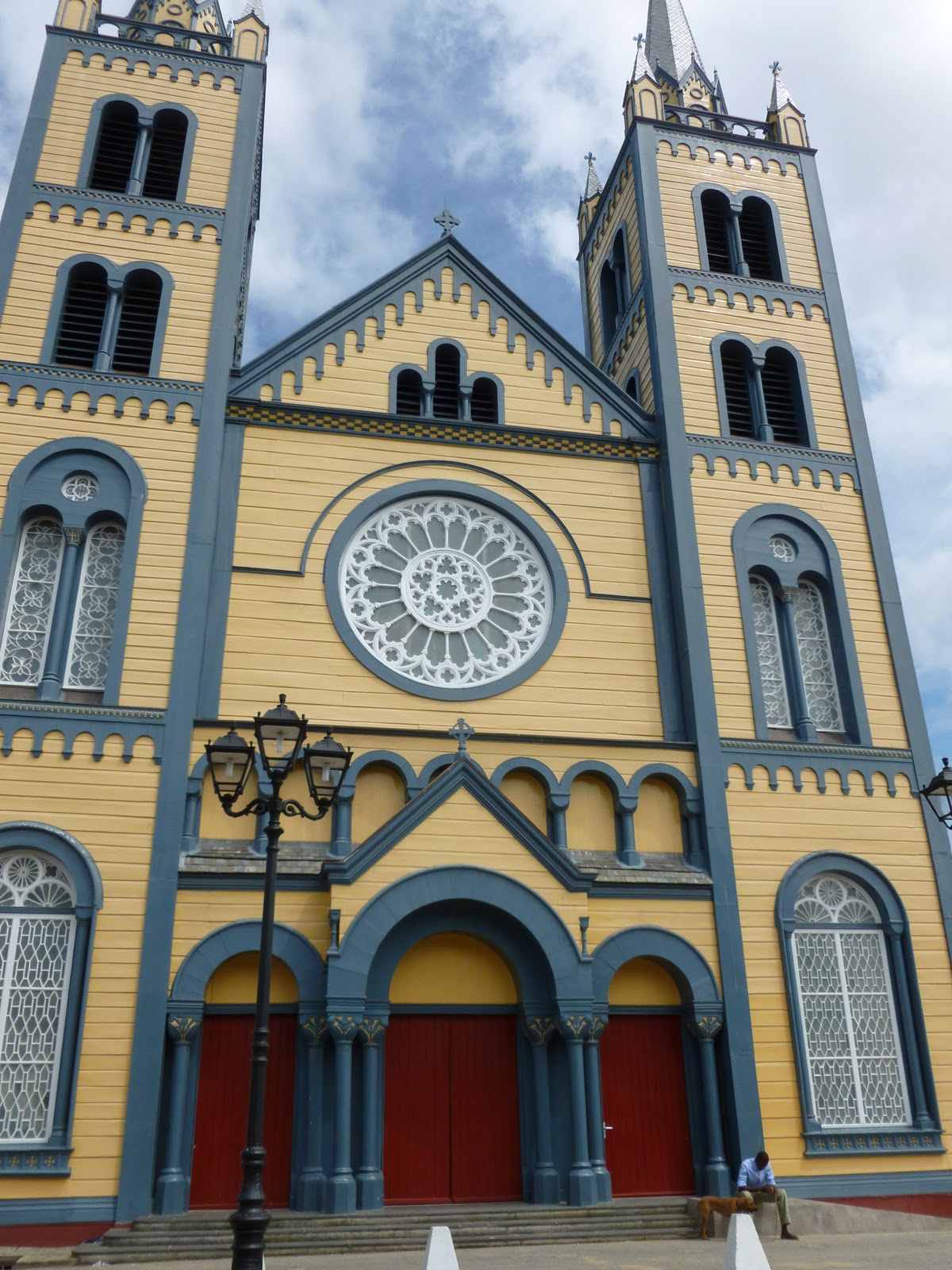
The more elaborate Catholic Church of St Peter and Saint Paul was originally a theatre.
Most of the churches are wooden: their careful maintenance suggests an active congregation.
New Year in Paramaribo 2
What are the differences between Guyana and Suriname?
From the minibus window, the countryside is similar: there are coconut trees, banana plantations, rice cultivation, drainage canals everywhere and minimal population, with homes and a few services strung along the road.
The road signs and occasional advertising hoardings are in Dutch, and the fuel stations are operated by Shell, instead of the familiar Guyoil-a reminder of the country's colonial past, and the continued support of the Dutch government, since independence from the Netherlands, granted in 1975.
As we approached the capital there were indicators of relatively greater prosperity in Suriname:- homes either an upper storey on stilts or a bungalow looked well maintained; larger stores and local convenience shops were selling a greater range of goods and services.
Within the capital, the places of worship reflect not just the religious, but also the ethnic and political mix and allegiances of the country.
From the minibus window, the countryside is similar: there are coconut trees, banana plantations, rice cultivation, drainage canals everywhere and minimal population, with homes and a few services strung along the road.
The road signs and occasional advertising hoardings are in Dutch, and the fuel stations are operated by Shell, instead of the familiar Guyoil-a reminder of the country's colonial past, and the continued support of the Dutch government, since independence from the Netherlands, granted in 1975.
As we approached the capital there were indicators of relatively greater prosperity in Suriname:- homes either an upper storey on stilts or a bungalow looked well maintained; larger stores and local convenience shops were selling a greater range of goods and services.
Within the capital, the places of worship reflect not just the religious, but also the ethnic and political mix and allegiances of the country.
| An austere Dutch protestant church |
New Year in Paramaribo
On the 28th December, at 4.30 am, Tessa (fellow VSO teacher, from the Netherlands) and I set off in Brian's minibus, starting the 348 km journey by road and ferry to Paramaribo, capital of neighbouring Suriname. The paired minibus service-with complementing vehicles in each country-, which collects and drops off each passenger at personal addresses, works efficiently and reasonably quickly, given that once out of the towns, the connecting route is one two-lane road, decently maintained.
Conversely, the ferry service adopts its own time frame taken from an earlier century. The half hour crossing of the River Correntyne, in a large boat carrying foot passengers and up to 20 vehicles, is sandwiched between hours of queuing, while officials check passports, prepare tickets, inspect luggage or simply wait until the clock reaches the next hour: all documentation is hand written- slowly- in between answering the phone, disappearing into a back office, breaking off to discuss with a colleague.
And so, 11 hours later, we reached our destination, quickly unpacked, and headed for town.
Boarding the ferry at Moleson Creek, Guyana.
The boat docks at the beautifully named Southdrain terminal, Suriname.
Conversely, the ferry service adopts its own time frame taken from an earlier century. The half hour crossing of the River Correntyne, in a large boat carrying foot passengers and up to 20 vehicles, is sandwiched between hours of queuing, while officials check passports, prepare tickets, inspect luggage or simply wait until the clock reaches the next hour: all documentation is hand written- slowly- in between answering the phone, disappearing into a back office, breaking off to discuss with a colleague.
And so, 11 hours later, we reached our destination, quickly unpacked, and headed for town.
![]() |
| (photo-internet) |
The boat docks at the beautifully named Southdrain terminal, Suriname.
Wednesday, 28 December 2011
Christmas Day 4
And the Pepper Pot- close up- trying to identify the animal parts.
After we had eaten the main course, then the fruit cake and pumpkin pie (all home made) there was an elaborate charades/quiz/word game to be played, which got noisier and for some, more and more competitive with each round. (Our team came joint first!)
So Christmas Day ended with good food, silly games, friendship and a sense of making the best of what we have.
And as I had Skyped with my family too- it had been a good day.
After we had eaten the main course, then the fruit cake and pumpkin pie (all home made) there was an elaborate charades/quiz/word game to be played, which got noisier and for some, more and more competitive with each round. (Our team came joint first!)
So Christmas Day ended with good food, silly games, friendship and a sense of making the best of what we have.
And as I had Skyped with my family too- it had been a good day.
Christmas Day 3
We did recover ourselves- with tea or something stronger according to taste.
A number of volunteers have previously worked in orphanages, either here in Guyana or in other developing countries.
Gradually the Christmas mood took hold, and the shared "Pot Luck" meal was enjoyed.
Each dish sort of complemented the others in a strange but tasty way. The Star Performer, as far as Guyanese tradition goes, was the Pepper Pot, a flexible simmered meat stew, prepared with assorted meats according to the buying/acquiring power of the cook. Interestingly, our offering included some of the cheaper cuts recommended- cow's cheek, ox tail, cow heel: I found the pepper sauce or gravy nicely savoury and tasty, but as there was so much tempting food on the table, I had to pass on the quivering piece of meat flesh on my plate!
A number of volunteers have previously worked in orphanages, either here in Guyana or in other developing countries.
Gradually the Christmas mood took hold, and the shared "Pot Luck" meal was enjoyed.
Each dish sort of complemented the others in a strange but tasty way. The Star Performer, as far as Guyanese tradition goes, was the Pepper Pot, a flexible simmered meat stew, prepared with assorted meats according to the buying/acquiring power of the cook. Interestingly, our offering included some of the cheaper cuts recommended- cow's cheek, ox tail, cow heel: I found the pepper sauce or gravy nicely savoury and tasty, but as there was so much tempting food on the table, I had to pass on the quivering piece of meat flesh on my plate!
| Shared Christmas Day meal |
Christmas Day 2
Our next appointment took us to a nearby orphanage.
As reported in previous postings, there is a significant proportion of orphans and vulnerable children in Guyana's under 18 population:- UNICEF surveys estimate about 11%.
While the orphanage was well run, with dedicated staff who commit to their work, for 39 years in the case of the matron, the low staff numbers mean that children lack the individual attention necessary for emotional development.
The children were all well fed and clothed. There were plenty of toys and play facilities. The staff were pleasant and patient with the children.
As recommended, we brought a selection of picture books and simple readers, but the children were far too excited and full of sugar to settle to listen, so we played group singing games, then went into the garden area.
A couple of us were allowed to visit the nursery where the babies and toddlers were being bathed, one at a time, and then settled for afternoon naps in rows of cots.
It was here that the realisation dawned that each child has no significant adult in their lives to give them the unconditional love and affection of a parent. I had to go to a quiet corridor to recover myself.
I can understand why travellers and those who work abroad in poorer countries sometimes return home with an adopted orphaned child.
Talking through, rationalising, theorising and resolving one's own actions are needed- otherwise anyone could be easily overwhelmed by the enormity of such problems.
Our return back to our apartments was much quieter than the journey out.
As reported in previous postings, there is a significant proportion of orphans and vulnerable children in Guyana's under 18 population:- UNICEF surveys estimate about 11%.
While the orphanage was well run, with dedicated staff who commit to their work, for 39 years in the case of the matron, the low staff numbers mean that children lack the individual attention necessary for emotional development.
The children were all well fed and clothed. There were plenty of toys and play facilities. The staff were pleasant and patient with the children.
As recommended, we brought a selection of picture books and simple readers, but the children were far too excited and full of sugar to settle to listen, so we played group singing games, then went into the garden area.
A couple of us were allowed to visit the nursery where the babies and toddlers were being bathed, one at a time, and then settled for afternoon naps in rows of cots.
It was here that the realisation dawned that each child has no significant adult in their lives to give them the unconditional love and affection of a parent. I had to go to a quiet corridor to recover myself.
I can understand why travellers and those who work abroad in poorer countries sometimes return home with an adopted orphaned child.
Talking through, rationalising, theorising and resolving one's own actions are needed- otherwise anyone could be easily overwhelmed by the enormity of such problems.
Our return back to our apartments was much quieter than the journey out.
Christmas Day
"Tradition" is what you make for yourself.
Doing something because "we always do this" can become empty.
And making the best of whatever you have is, in itself, a fine tradition.
Happily, for families anywhere around the world, if there is access to some sort of internet link or decent phone connection, loved ones can be reached on Christmas Day and the unsettling yearning for contact is satisfied.
And so, on a bright and sunny Christmas morning, this was my first mission for the day:- my daughters Rosie and Clare, sister Denise and brother Paul all wished a Merry Christmas!
Then, it was back to making the best of the day.
Bearing the fruits of kind donations from back home in the UK and here in Guyana, a number of volunteers set off, some by taxi, others on bicycles, to our appointments at the rest home for the elderly and the children's orphanage.
Both the staff and residents at the home greeted us and after exchanging conversations in small groups, the matron led the carol singing and we all joined in lustily. There were no expressions of self pity, rather gratitude for having a roof over one's head and a single room. Our visit ended with a reminder that all the residents had grown up under British rule and sung "God Save The Queen" as children, but now we would proudly sing "Dear Land of Guyana" together.
The generosity of donations allowed us to buy gifts for the staff, and have a surplus of packages:- most have since been taken to another home for elderly residents; one was given to a member of staff, as a gesture of sympathy when we learned she had returned home the previous night to find her home burgled.
Doing something because "we always do this" can become empty.
And making the best of whatever you have is, in itself, a fine tradition.
Happily, for families anywhere around the world, if there is access to some sort of internet link or decent phone connection, loved ones can be reached on Christmas Day and the unsettling yearning for contact is satisfied.
And so, on a bright and sunny Christmas morning, this was my first mission for the day:- my daughters Rosie and Clare, sister Denise and brother Paul all wished a Merry Christmas!
Then, it was back to making the best of the day.
Bearing the fruits of kind donations from back home in the UK and here in Guyana, a number of volunteers set off, some by taxi, others on bicycles, to our appointments at the rest home for the elderly and the children's orphanage.
Both the staff and residents at the home greeted us and after exchanging conversations in small groups, the matron led the carol singing and we all joined in lustily. There were no expressions of self pity, rather gratitude for having a roof over one's head and a single room. Our visit ended with a reminder that all the residents had grown up under British rule and sung "God Save The Queen" as children, but now we would proudly sing "Dear Land of Guyana" together.
The generosity of donations allowed us to buy gifts for the staff, and have a surplus of packages:- most have since been taken to another home for elderly residents; one was given to a member of staff, as a gesture of sympathy when we learned she had returned home the previous night to find her home burgled.
Subscribe to:
Posts (Atom)
